
Is Lane Splitting Legal in AZ
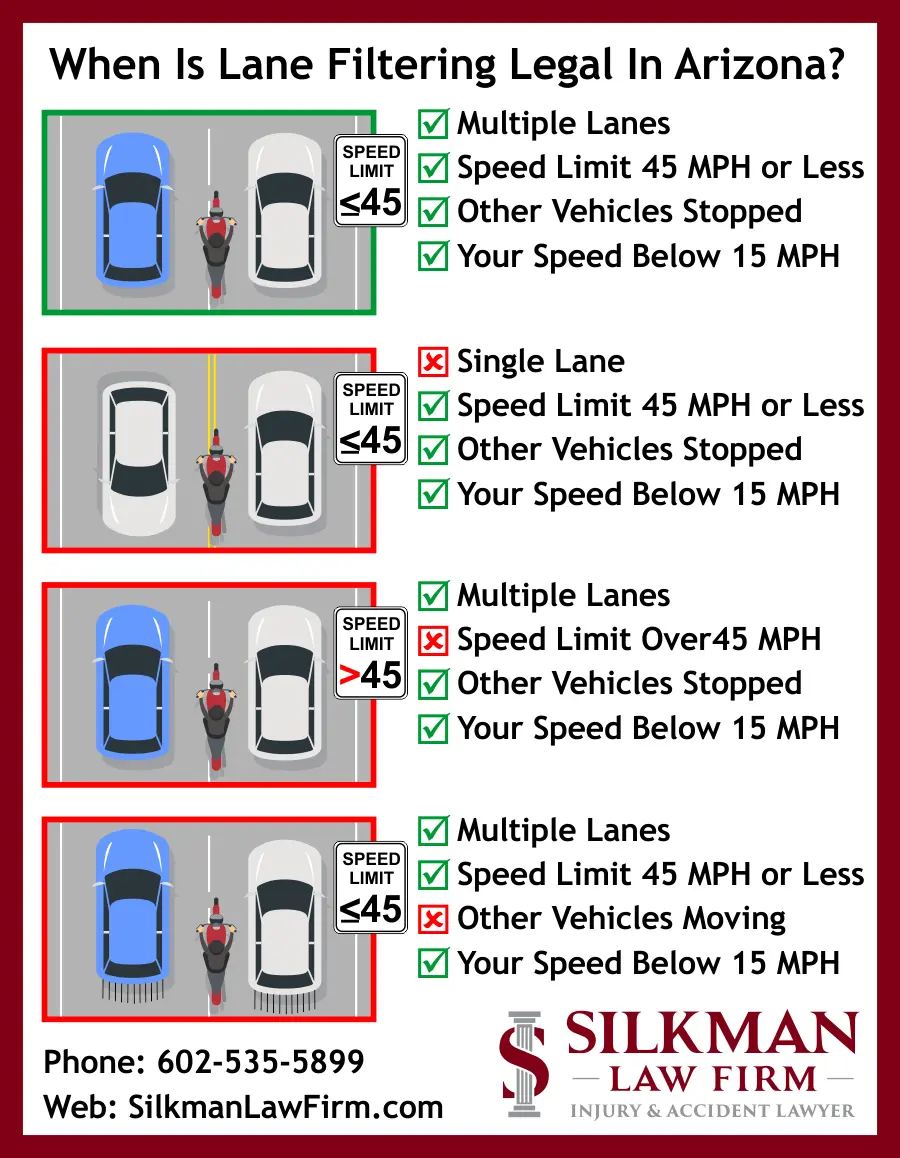
In Arizona, lane splitting is illegal, but lane filtering is allowed. Lane filtering is a practice where two-wheeled motor vehicles may advance through stopped traffic on multi-lane roadways (with speed limits of 45 mph or less) at a speed limit of 15 mph or less.
Proper movement using lane filtering between vehicles reduces traffic congestion and protects motorcyclists from rear-end collisions. Illegal lane splitting risks traffic violations, accidents, and denied claims. For legal guidance regarding personal injury after an incident involving movement between vehicles or any type of motor vehicle, contact Phoenix Attorney Alex Silkman for a free case evaluation.
Motorcyclists often face gridlocked roads in Phoenix and across the United States. When traffic grinds to a halt, many bikers wonder if they can maneuver between stopped vehicles to save time. Although the act of driving between moving traffic is illegal in Arizona, a related practice called lane filtering between stopped vehicles is permitted under strict conditions.
Is Motorcycle Lane Filtering Legal in Arizona?
Movement between stopped cars allows motorcycles to advance to the front of stopped traffic by traveling between stationary vehicles, but only when the posted speed limit is 45 mph or less and the motorcycle’s speed does not exceed 15 mph. This means that lane filtering is never allowed on I-10, I-17, I-40, and the 101, 202, or 303, as these have posted speeds higher than 45 mph.
This practice helps ease traffic congestion and reduce rear-end collisions, but it must be performed safely to protect both motorcycles and motor vehicle drivers.
Understanding the difference between riding on the painted lane dividers, weaving in and out of slow-moving traffic, and riding between stopped vehicles is crucial for Arizona motorcycle riders. While other state laws, like California, Utah, New Mexico, and Washington state, have varying rules, Arizona's recent changes under ARS § 28-903.1 sets clear boundaries. This new rule was signed into law on September 24th, 2022, by then-Governor Doug Ducey.
Motorcyclists who move between stopped vehicles correctly can benefit from reduced traffic delays without risking illegal traffic violations. Arizona is the fourth state with a lane-splitting ban.
For legal guidance after a lane filtering incident or any motorcycle accident, contact your Phoenix personal injury attorney, Alex Silkman, at 602-517-0242 for a complimentary case evaluation.
Legally Reviewed By:
Alex Silkman
Alex Silkman is the founder and managing member of Silkman Law Firm Injury & Accident Lawyer. He focuses exclusively on personal injury and wrongful death cases, with the goal of getting truly just results for accident victims and their families...
Defining Lane Splitting vs. Lane Filtering vs. Lane Sharing
Lane splitting between vehicles involves operating a motorcycle between moving traffic, often at higher speeds than surrounding larger vehicles. It may also be referred to as white-lining or stripe-riding.
This practice is illegal in Arizona and can lead to traffic violations, citations, fines, or worse, an accident that injures the motorcyclist or other motorists. Motorcycle safety research shows that lane splitting between traffic elevates the risk of an accident, especially in blind spots or during sudden lane changes by other vehicles.
Lane filtering occurs between stopped vehicles. Arizona law allows motorcycles to move between stationary vehicles. Putting them at the front of the line of traffic, where they are safer from rear-end collisions.
Arizona’s lane-filtering law permits motorcycles to move between stopped vehicles only when all motor vehicles in adjacent lanes are stopped, the street has at least two lanes in the same direction of travel, and both the posted speed limit and the motorcycles’ speed stay within specified limits.
Following these guidelines helps reduce traffic congestion and warrants ongoing research by safety transportation researchers and the American Motorcyclist Association.
Lane sharing is when two motorcycles ride next to or in a staggered formation and "lane share" a single traffic lane. This is perfectly legal under Arizona law.
Arizona Lane Filtering Law and Its Requirements
Under Arizona's law, motorcyclists may legally move between vehicles only under specific circumstances:
- Stationary Vehicles: Vehicles in adjacent areas must be entirely halted.
- Multiple Lanes: The road must feature at least two motor vehicle lanes traveling in the same direction.
- Speed Limits: The posted maximum speed limit must not exceed 45 mph; the motorcyclist's speed must stay at or below 15 mph.
- Safety: Motorcyclists filtering through traffic must move between stopped vehicles without creating undue risk to other drivers, other road users, or pedestrians.
These requirements reflect input from the House Transportation Committee, Senator Tyler Pace, and various advocacy groups, including ABATE of Arizona. The Arizona lane-filtering law strikes a balance between easing urban-area traffic flow and maintaining road safety.
Periods of intense traffic, such as morning commutes or rush-hour gridlock near traffic lights, increase the risk of a rear-end collision or being caught in the rear of a line of vehicles.
To minimize accidents, motorcyclists should adhere to Arizona’s specific conditions and practice moving between stopped vehicles only in calm, stopped traffic, avoiding weaving between moving traffic.
Call your Phoenix motorcycle accident attorney, Silkman Law Firm, at 602-517-0242 for a free consultation.
Safety Considerations and Risk Management
Common Causes of Motorcycle Accidents
- Failure of other drivers to see motorcycles
- Left-turning vehicles
- Speeding
- Impaired riding or driving
- Distracted driving
- Unsafe lane change
- Following too closely
- Failing to remain visible at all times to other motorists
- Road hazards
- Aggressive driving/riding
- Braking improperly
- Poor weather conditions
- Motorcycle defects
Liability and Insurance Implications
When investigating an accident, insurance companies will closely examine how the vehicles were being driven in the lead-up to the crash. If a motorcyclist was lane splitting illegally before the accident, their insurance claim might be rejected, or they may be found partially liable for the accident. Even if the motorcyclist was moving through stopped traffic legally, they need to demonstrate that they followed the specific Arizona law regarding lane filtering to convince the insurance company that they were driving safely and in accordance with the law.
Phoenix motorcycle accident lawyers often rely on police reports, traffic camera footage, and post-accident inspection reports to establish whether the motorcycle moved between stopped vehicles within legal parameters.
Proper documentation of the time of the crash, precise location on the road or highway, and statements from witnesses can tip the balance in favor of a motorcyclist who followed the lane-filtering law correctly.
Frequently Asked Questions
Below are answers to common questions about Arizona’s lane-filtering rules and motorcycle crash claims. Get clear, concise guidance on your rights, safe riding practices, and next steps after an accident.
No. Arizona prohibits lane splitting. Only lane filtering, when all vehicles are stopped and speeds are low, is legal under ARS § 28-903.1 Section F. The only exception to this rule is law enforcement.
Here's the full text from ARS 28-903.1 legislation:
28-903. Operation of motorcycle on laned roadway; exceptions
- A. All motorcycles are entitled to the full use of a lane. A person shall not drive a motor vehicle in such a manner as to deprive any motorcycle of the full use of a lane. This subsection does not apply to motorcycles operated two abreast in a single lane.
- B. Except as provided in subsection F of this section, the operator of a motorcycle shall not overtake and pass in the same lane occupied by the vehicle being overtaken.
- C. Except as provided in subsection F of this section, a person shall not operate a motorcycle between the lanes of traffic or between adjacent rows of vehicles.
- D. A person shall not operate a motorcycle more than two abreast in a single lane.
- E. Subsections B and C of this section do not apply to peace officers in the performance of their official duties.
-
F. The operator of a two-wheeled motorcycle may overtake and pass another vehicle that is stopped in the same direction of travel and in the same lane as the operator and may operate the motorcycle between lanes of traffic if the movement may be made safely and if the operator does both of the following:
-
Operates the motorcycle on a street that both:
- Is divided into at least two adjacent traffic lanes in the same direction of travel.
- Has a speed limit that does not exceed forty-five miles per hour.
- Travels at a speed that does not exceed fifteen miles per hour.
-
Operates the motorcycle on a street that both:
Riders caught lane splitting can receive traffic violation citations, fines, and may face liability for any resulting accidents or injuries. Motorcycle riders are also at risk of sustaining major injuries such as traumatic brain injuries (TBIs) or spinal injuries.
The recent change making lane filtering legal can help safe riders avoid being struck from behind in heavy traffic, provided you follow Arizona’s strict guidelines.
Studies of lane filtering have shown a reduction in motorcycle rear-end crashes, allowing bikers to avoid being caught between a stopped vehicle ahead of them and a car or truck that strikes them from behind.
Gather photos of any injuries, get immediate medical attention, obtain a police report, preferably one in which the driver of the car was found at fault, and call Phoenix motorcycle accident attorney, Alex Silkman, for a complimentary case evaluation.
Get Your Free Consultation at Silkman Law Firm
Alex Silkman is ready to stand by your side and fight for the justice and compensation you deserve. With personalized attention and no fees unless you win, getting started is simple. Reach out today.
Ready to protect your rights? Contact the Phoenix attorney at Silkman Law Firm now at 602-517-0242 for your complimentary consultation. No fees unless a settlement is reached.